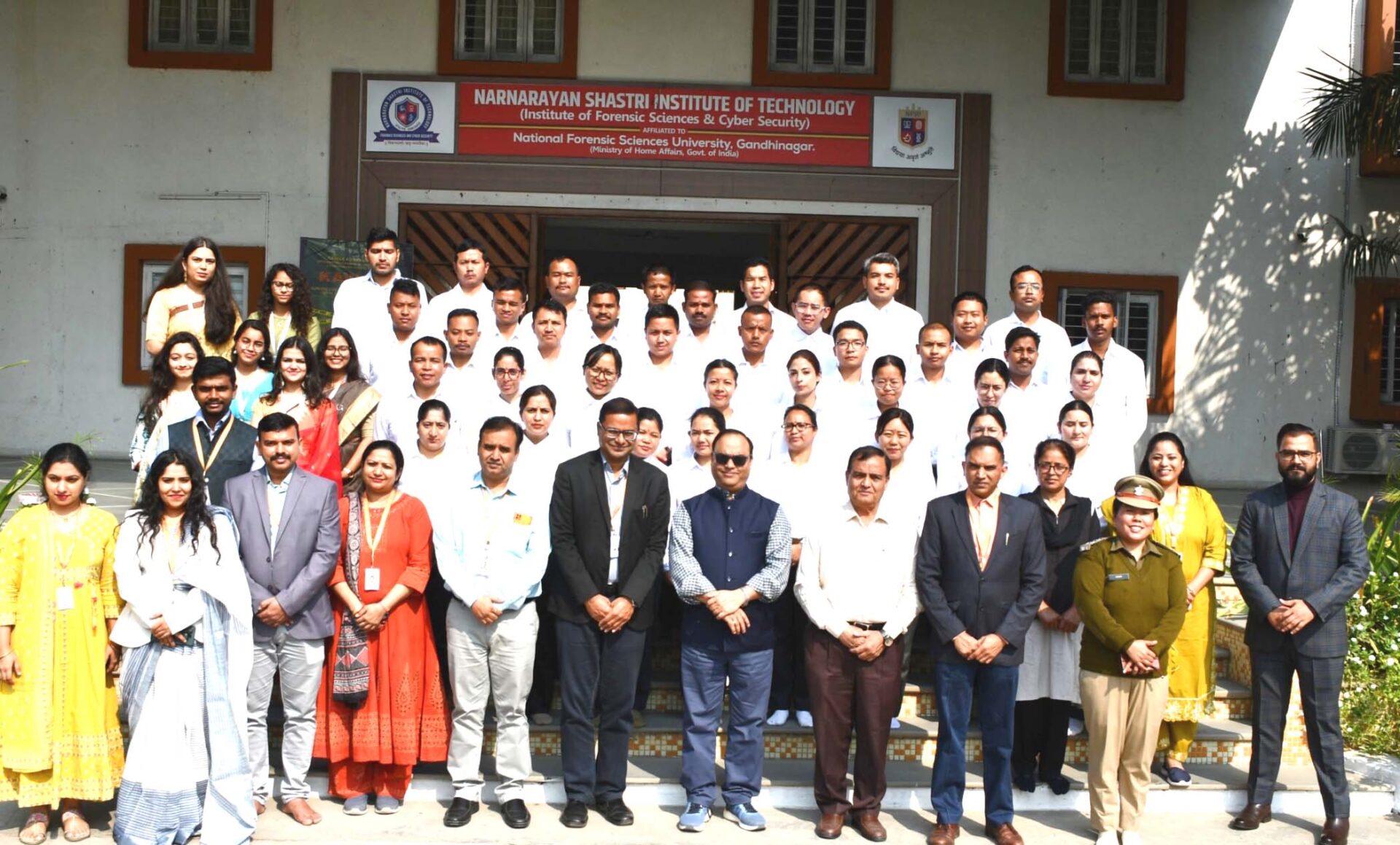
NSIT-IFSCS Jetalpur Emerges as a National Center for Wildlife Forensic Training: Advanced Training Imparted to Uttarakhand Forest Officers Under Project ‘KAWACH’
Wildlife Forensic Workshop organized for Range Forest Officers of Uttarakhand under the aegis of the Training Department of NSIT-IFSCS.
Ahmedabad (WhatsApp- 6367472963)
The Narnarayan Shastri Institute of Technology – Institute of Forensic Science and Cyber Security (NSIT-IFSCS) has established a new milestone in the field of wildlife conservation. The institute successfully concluded a three-day intensive national training program named “KAWACH” (Knowledge for Advanced Wildlife Analysis & Crime Handling).
Range Forest Officers (RFOs) from the Uttarakhand Forestry Training Academy participated in this program held from January 21 to 23, 2026. This special program was organized by the Training Department of NSIT-IFSCS under the leadership of the director training Dr. Kalpesh Solanki.
The program was inaugurated by Shri S. K. Srivastava (IFS), Additional Principal Chief Conservator of Forests (APCCF – Research & Training), Gujarat State. In his inaugural address, he emphasized “Technology-enabled investigations” to counter modern-day poachers. Principal of NSIT-IFSCS, Prof. (Dr.) Sailesh Iyer, welcomed the guests and clarified the institute’s role in national-level capacity building.
The curriculum prepared by the Training Department included the following cutting-edge subjects. Dr. Shivani Pandya, Head of Research and Development (R&D) at NSIT-IFSCS, played a key role in providing a scientific perspective to this workshop. Commencing the academic sessions, Dr. Pandya explained the fundamental principles of forensic science and clarified its importance in investigating wildlife crimes to the officers.
Dr. Parvesh Sharma provided technical training on field investigation. He conducted sessions on ‘Wildlife Crime Scene Management’, teaching how to secure evidence without contamination. He also gave special training in forensic photography so that officers can document crime scenes in a manner admissible in court.
The training program reached a pinnacle with an intellectually stimulating and highly detailed lecture by the legendary Dr. Keshav Kumar, IPS (Retd.) Former Director General of Police & Director, ACB, Gujarat State, a pioneer who institutionalized wildlife forensics in India. Dr. Keshav Kumar delved deep into the “Investigator’s Mindset” emphasizing that a crime scene is a silent storyteller that requires scientific temper and unwavering persistence to decode. He illustrated his philosophy through the chilling and world-renowned 2007 Gir Lion Poaching Case, where his groundbreaking use of human forensics on animal crime scenes led to the conviction of organized poachers. By collecting blood samples from the suspects’ clothes and matching them with the DNA of the slaughtered lions, and using footprint analysis (pugmarks) alongside finger-printing, he demonstrated how forensic science can bridge the gap between suspicion and conviction. The trainees were profoundly inspired by his “out-of-the-box” approach, particularly how he treated the forest floor as a traditional crime scene, leading to the arrest of the ‘Baheliya’ gang members. The officers expressed immense appreciation for the session, noting that Dr. Kumar’s real-life case studies didn’t just teach them law and science, but ignited a transformative shift in their analytical thinking elevating their perspective from traditional patrolling to sophisticated, evidence-based criminal investigation.
Dr. Gaurang Sindhav apprised the officers of the intricate subject of ‘Forensic Entomology’ (insect science). He taught how the time since death (PMI – Post Mortem Interval) and the cause of death can be determined through the activity of insects and larvae found on the carcass of an animal. This knowledge is crucial for distinguishing between natural death and poaching.
Dr. Kalpesh Solanki took a masterclass on the “Role of DNA as Evidence.” He trained the officers on how to use DNA for Species Identification and the precise methods of collecting Biological Evidence to prove cases in court.
Dr. Nikunj Tahilramani, Head of the Cyber Security Department, and Shri Vinay Aseri highlighted the use of Cyber Forensics and Artificial Intelligence (AI) in wildlife crime analysis.
Outside the classroom, under the leadership of Forensic Department faculty Shri Anant Patil and Shri Aromal Venugopalan, the officers participated in practical exercises such as Grid Searches, crime scene cordoning, crime scene photography, collection of wildlife samples, packaging, forwarding, and maintaining the chain of custody.
The participants appreciated the excellent customized content, practical hands-on experiments and excellent quality delivery by the Resource Persons making this Training a resounding success.
The entire program was successfully organized under the guidance of Principal Prof. (Dr.) Sailesh Iyer and Campus Director Shri Sanjay Sharma. The organizing committee members Dr. Geeta Gupta, Dr. Shivani Pandya, Dr. Harjit Singh, Dr. Khushbu Gautam, Dr. Sachin Dev, Dr. Kuldeep Purohit, Shri Anant Patil, and Shri Aromal Venugopalan, Mr. Krishna Sharma and student volunteers worked hard to make the program a success.
With this initiative, NSIT-IFSCS has strengthened its position as a leading center for wildlife forensic training in India.